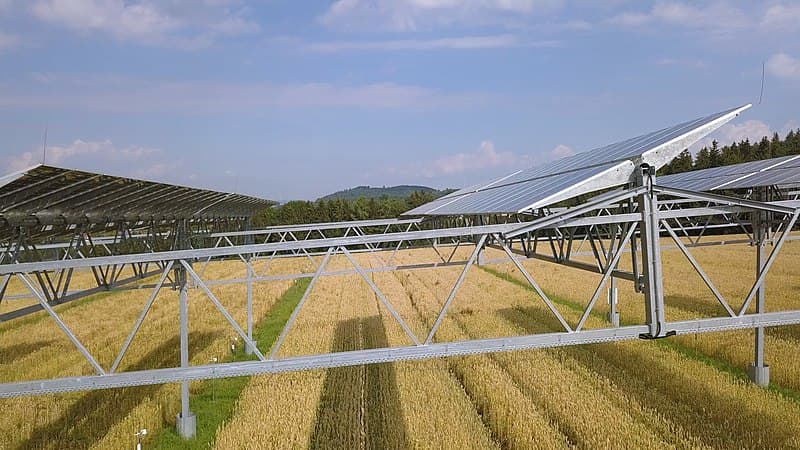
Agrivoltaica, a merging of “agriculture” and “voltaic” electrical energy, is a progressive method combining agricultural practices with solar photovoltaic (PV) systems. This holistic approach addresses the challenge of optimizing land use for both food production and clean energy generation. This article explores the concept of agrivoltaica, delving into its advantages, challenges, and its potential impact on sustainable energy and agriculture.
Efficient Land Use
Agrivoltaica tackles the issue of competing land use by seamlessly integrating solar panels into agricultural landscapes. This approach enables the simultaneous utilization of land for food production and electricity generation.
Increased Crop Yields
Surprisingly, research indicates that agrivoltaic systems can positively influence crop growth by creating a favourable microclimate. The shade provided by solar panels reduces water evaporation, offering a more stable environment that can contribute to enhanced agricultural productivity.
Environmental Benefits
Agrivoltaic systems contribute to environmental conservation by minimizing the need for additional land for solar farms. The shade provided by solar panels also helps mitigate the impact of extreme weather conditions on crops, aligning with global efforts to address climate change.
Community Engagement
Agrivoltaic projects often receive community support due to their dual-purpose nature. By addressing energy needs while sustaining agricultural practices, these projects contribute to local economies and foster a sense of shared responsibility for sustainable development.
Challenges and Considerations
While agrivoltaica offers numerous benefits, challenges exist in balancing the requirements of both solar energy production and agriculture. Factors such as crop selection, panel height, and maintenance must be carefully considered. Additionally, assessing the economic viability of agrivoltaic systems is crucial to ensuring their long-term sustainability.
Conclusion
Agrivoltaica represents a promising synergy between agriculture and solar energy, showcasing the potential for innovative solutions to global challenges. By optimizing land use, enhancing crop yields, and contributing to environmental sustainability, agrivoltaic systems offer a vision of a future where clean energy and agriculture can coexist seamlessly. As technology advances, agrivoltaica stands as a symbol of progress, illustrating that the pursuit of sustainability can be a collaborative effort benefiting both the planet and its inhabitants.
Sources
-
Dinesh Panday et al. “Effects of Solar Panel Arrays on Microclimate and Soil Properties in Agricultural Systems.” Scientific Reports, 2019.
-
National Renewable Energy Laboratory (NREL). “Agrivoltaics: An Overview of the Benefits, Impacts, and Opportunities in the United States.” 2020.
-
Gemma Guttman, et al. “Solar panels in agriculture: Assessing the impact of shade on crop growth and yield.” PLOS ONE, 2019.
-
Fraunhofer Institute for Solar Energy Systems. “Agrivoltaics – Opportunities and Challenges.” 2020.
-
The World Bank. “Integrating Agriculture and Solar Photovoltaics: Opportunities and Challenges.” 2017.